BAC
VAI Nevada Neighbors
Program
Karen Moss Essay [Design Draft 0.9b]
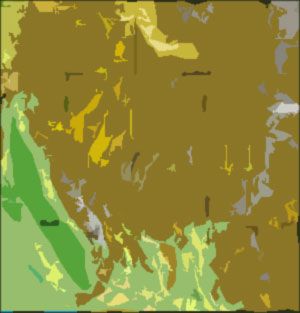
Topographies: A Look At Contemporary Visual Art in California
by Karen Moss
topography
1) the art or practice of graphic delineation in detail of natural and
man-made features of a place or region especially in a way to their relative
positions and elevation
2) the physical or natural features of an object or entity and their structural
relationships
In these traditional definitions from
Webster's Dictionary the word "topography" refers to the creation
of a metaphorical equivalent in words of a specific, physical landscape.
Most often the meaning of topography refers to the representation of a
landscape according to some conventional signs or systems of mapping (ie:
a topographic map.) With the permutation of language and its shifting
significance prevalent in post-modern thought of recent years, the idea
of topography as a singular, fixed entity has blurred into a realm of
multi-valent meanings of many topographies. The more limited definition
of topography used by cartographers and geographers may now be found in
diverse contexts ranging from art and architecture to medicine and metallurgy,
or realms of science and technology. The very concept of a singular definition
of topography, therefore, has evolved into multiple spatial configurations
and broken through boundaries of discrete disciplines.
This exhibition will present artists who work with the ideas about different
topographies or whose subject can be considered under the general rubric
of the "topographical." Less about the traditional genres of
landscape or cityscape, their representations are about specific localities
and/or senses of place. Including both natural and man-made subjects,
the rural and the urban, some topographical works refer to a location
in "real" space, while others are fictional. Traversing across
definitions and disciplines and media, artists are using divergent materials
and media to represent their various topographies, which range from the
literal to the conceptual. The artists all share an interest in some kind
of mapping, marking, siting, place-making, and an obsession with the aesthetics
of surface or space, which are often rendered in abstract, constructed,
imagined, invented, or even "hyperreal."
Their work ranges from more traditional and physical topographies related
to geography or cartography, to topographical mappings of cultural, social/psychological
spaces. Some are tangible and grounded in a precise location or space,
while others are fantasized, imagined or projected. Temporally, these
topographical expressions are memories of the things past, firmly anchored
in the present, or looking toward the future; the artists use time and
space to construct meaning for their own respective topographies.
Ultimately, the group of artists in this exhibition all make visual representation
of an observed, occupied or invented place, however, they are less interested
in describing and more concerned with the idea of delineating or demarcating.
Many are more influenced by the strategies of conceptual art of the 1960s
and 1970s than they are by more traditional modes that represent the landscape
or the environment. And, because they are from California, the idea of
"shifting" in aesthetics, space, language, and in the "terra
firma" itself are prevalent.
However, rather than revisiting the polemical and often parochial stereotypes
of the differences between art from Northern and Southern California that
prevailed in the 1950s-1960s, this exhibition attempts to understand the
diversity of these artistic sensibilities in a new context-the way some
21st century California artists use the subject of topography to explore
the delicate balance between nature and culture. And, since California
has the largest, most diverse populations of any state and is one of the
richest examples of varied topographies and geo-morphologies, the exhibition
will show how some artists are interested in the physical or social aspects
of the urban environment, while other prefer to explore nature outside
the city.
Given the aspects of our demographics and our terrain, an additional objective
to the exhibition and the site-specific projects is to examine how the
artists explore current environmental and cultural issues. For instance,
as industry, technology and urban sprawl continue to encroach upon the
landscape is there a related increase in an artist's desire to describe,
reconstruct or mark a specific location in nature, the built environment
or a social space? Is there a need for artists to reclaim or re-imagine
a particular place because of its potential metamorphosis, or complete
loss, through environmental threat? How do the changing notions of topography
in our increasingly technological and digitized world affect artists'
relationship to place? Does this increase artists' interest in the more
tangible, physical properties of a given topography, or, conversely, does
this inspire imagined or virtual topographies? Is a particular artists'
tendency towards the topographical, more personal, related to their own
corporeal presence? Is it perceptual, do they observe or represent the
phenomenology of a place? Or, is it purely aesthetic, an engagement with
the history of of art, architecture or another aspect of visual culture?
While at this point the Topographies exhibition may elicit more questions
than it answers, the final fruition of the exhibition and its related
site specific projects, publication, web-site and public programs will
provide different avenues for understanding the multiple meanings of the
topographic, with a potential impact on audiences not only at the Art
Institute and in San Francisco, but throughout the state of California
and far beyond.
The Topographies exhibition will be on view in the Walter and McBean Galleries at the San Francisco Art Institute from March 18 - May 10, 2004.